If you are used to being in front of a computer all day or if you are feeling stiffness in your lower back, there is a very simple seated yoga posture that is known to help - Vakrasana. This easy spinal twist is one of the first postures that is introduced to the students of a yoga teacher training India, and rightly so. It is easy to practice, it’s equipment free, and it mainly benefits the spine, core, and digestion.
In this article, we will talk about Vakrasana, what it means, step-by-step procedure of Vakrasana, its variations, benefits supported by science, and who should not perform it. Whether you do yoga at home or you are preparing for a yoga retreat rishikesh, it’s a pose that should be part of your daily routine.
What is Vakrasana? Meaning and Introduction
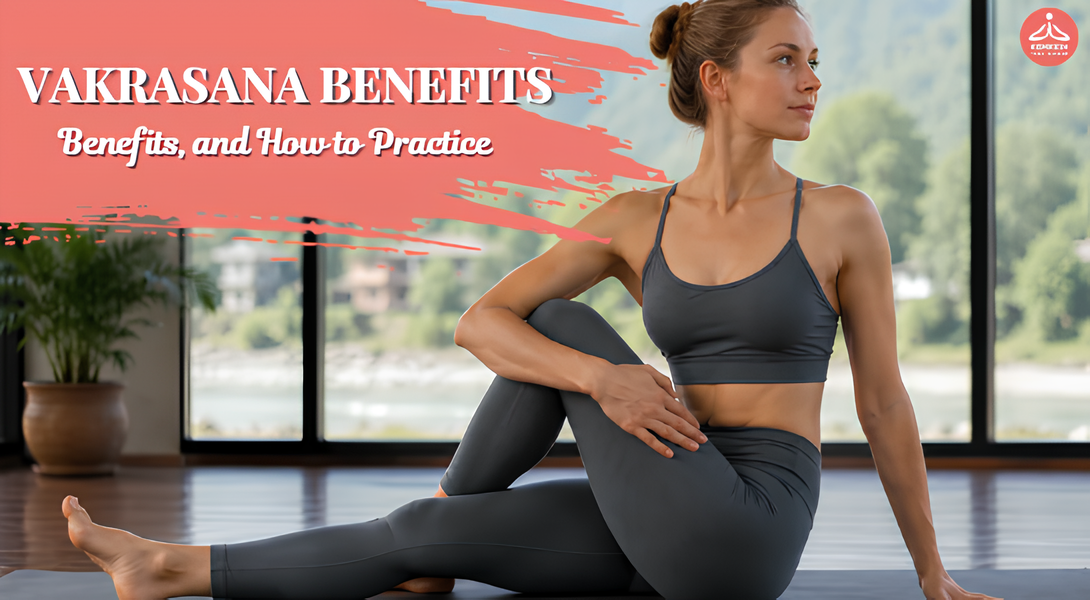
The term “Vakrasana” is derived from two Sanskrit words, “Vakra,” which in Sanskrit means “twisted” or “curved,” and “Asana,” which means “pose” or “seat.” Therefore, “Vakrasana” meaning “Twisted Pose.” However, it is more often referred to as “Half Spinal Twist Pose” as it is thought to be a beginner-friendly and simplified version of the Ardha Matsyendrasana pose.
The session of Wakrasana falls in the category of seated twist asanas. In contrast to other postures that require advanced twisting skills in hips and shoulders, the position of Wakrasana involves one leg extended while the other is bent, making it easier for the beginners in yoga. Thus, yoga trainers usually teach the asana at the initial classes in yoga teacher training in rishikesh.
The twisting of the spine in this pose enables relief of tension in the abdomen which is claimed to help stimulate the digestive organs and improve blood circulation to the abdomen and the digestion process, which is proved by the results of various scientific research in this area.
Vakrasana Steps: Procedure of Vakrasana
Given below is the process of vakrasana procedure in easy steps. It is better to practice this asana on an empty stomach and early in the morning on a yoga mat.
- Sit in dandasana: Sit on the floor with a straight spine and legs extended in front.
- Bend the right leg: Now fold your right leg, placing your foot outside your left knee. The shin should be vertical.
- Use your left arm: You now need to take your left arm and put it against the outer side of your right knee, but if you are flexible enough, you can grab your right ankle or big toe.
- Put your right hand behind your back: Place your right hand behind your back, and let your fingers and palm be on the floor.
- Twist your body: Now, while inhaling, keep your spine straight. While exhaling, move your torso and shoulder to the right, twisting your neck.
- Keep holding the position and take a breath: Once you are in the twisted position, hold it for 15-30 seconds, breathing gently and steadily the whole time. Make sure you're not bending your spine but rather keeping it lengthened.
- Come back out and switch sides: Return to the starting position and repeat the process on the left.
Typically, between 2 and 3 repetitions on each side should be enough for daily practice. Don't rush into execution. Your twisting needs to be a stretching process, not a strain.
Popular Variations of Vakrasana
One reason this pose is popular among practitioners is its adaptability — there is a variant perfect for everyone, regardless of their body type and ability.
- Ardha Vakrasana (Half Twist): A more beginner-friendly pose with a more relaxed and less intense twist.
- Kati Vakrasana (Standing Waist Twist): Typically performed in a standing position with twisting movement of the arms that resembles twisting the body in an upward position.
- Meru Vakrasana: This variation gets its name from "merudanda" (the spine) and involves using one arm to twist the torso in an enhanced manner.
- Uttana Vakrasana: An advanced version of the twist with both arms outstretched.
- Supta Vakrasana (Reclined Twist): This is a variation of a twist in a lying position.
- Standing Vakrasana: A twist done from a standing position, helpful in warming up the body before performing more difficult poses.
Usually, performing two to three rounds of this practice on both sides is enough for one session. Taking it easy while performing this as a twist should feel like stretching rather than straining the body.
Vakrasana Benefits
With regular practice of this pose, you can experience several physical and mental benefits:
- Enhances flexibility of the spine: The twisting motion releases the spine from stiffness that results from sitting for long hours by activating the spinal nerves.
- Strengthens the core: The twisting of the body activates the lower back area and the obliques, which contribute to functional strength of the core muscles in the long term.
- Facilitates digestion: The compression that takes place in the abdominal cavity is believed to stimulate the liver, pancreas and intestines, which helps improve digestion, as well as alleviate constipation.
- May decrease the waist circumference: Squeezing the stomach during the exercise may result in strengthening the oblique muscles of the torso.
- Helps in blood sugar management: Some studies associated with yoga point out that certain twisting poses contribute to better insulin management.
- Alleviates back pain: Since the pose helps to make the spine flexible and stretches back muscles, it is effective in reducing mild tension-related pain.
- Helps relax: Like other yoga sitting poses, the combination of breathing and movements helps calm down the mind.
Prepares you for advanced twists: Instructors frequently use this pose as the starting point for students to progress to more difficult postures such as Ardha Matsyendrasana or Full Spinal Twist.
Vakrasana Contraindications
Although it is generally safe for most people, this pose is not suitable for everyone. Do not practice or modify it in case you have had or are suffering from:
- Recent procedures on spinal cord, abdomen, or hip
- A hernia, slipped disc, or sciatica
- Any serious or chronic disorders that cause back pain
- An ulcer or hernia
- Being pregnant (especially the second and third trimesters)
If any of these conditions apply, do this pose only under supervision of a trained yoga instructor, or choose a gentler posture like Supta Vakrasana with some props.
Tips for a Safer Practice
- Do not try to manipulate your body in a twist; instead, allow yourself to breathe according to your body’s comfort level and, in turn, your body will tell you how far you can rotate it.
- Make sure to keep your sitting bones grounded on the mat.
- Twist the torso from the waist and up and not only the neck to achieve decent results.
- When doing this pose on an empty stomach, you will get the best results for your digestion.
- Do some mild preparatory stretches for your back before proceeding with the posture.
If you want to improve your practice of asanas with proper alignment and expert advice, you should consider taking a structured yoga teacher training course in India or attend a dedicated 14 days yoga retreat in rishikesh.
At Rishikesh Yoga Ashram, foundational poses like Vakrasana are taught with proper breath work and anatomical alignment as part of daily practice.
Bottom Line
Vakrasana is proof that you don't need anything complicated to achieve great results. A simple seated twist done for only a few minutes every day can make a difference in your spinal cord, strengthen your core muscles, help digestion, and relax your mind. First, learn how to perform the basic version of Vakrasana, take your time, and only then try variations such as Meru Vakrasana and Ardha Matsyendrasana once mastering the basics. With all yoga practices, consistency is important. Doing something simple and correct every day is much better than being too intense at your yoga class only once a week.
FAQs
1. What is Vakrasana and its benefits?
Vakrasana, which literally means "twist pose", is a simple seated twist posture during which one leg is extended in front, while the other is bent in the position with the upper body appearing as if it is twisted. The advantages of practicing Vakrasana are the improvement of flexibility in the spine, working on the core muscles, aiding digestion, relieving back stiffness, and calming the mind.
2. Who cannot do Vakrasana?
People who have experienced herniation of the disc, sciatica, undergone surgery on their abdomen or spine recently, or have had serious back pain, hernia, peptic ulcers or pregnant women, especially lately, should not perform this asana, and if they wish to perform it, they should do under an expert's supervision.
3. Is Vakrasana and Ardha Matsyendrasana the same?
No, they are interrelated but not equal to each other. At the same time, Vakrasana is a simplified version of Ardha Matsyendrasana which can be performed by beginners, in the same time as Ardha Matsyendrasana is a more complex asana requiring greater flexibility of the back and shoulders of the person.
4. What is the second name of Vakrasana?
Vakrasana is also called the Twisted Pose and the Half Spinal Twist in the English language.
5. How long should I hold Vakrasana?
Hold the pose on both sides for about 15-20 seconds, gradually increasing the duration on both sides to 30 seconds when flexibility increases, and focusing on slow breathing.
6. Can Vakrasana help with weight loss?
While recurring compression can help tone the waist and oblique muscles, the posture is the most effective as part of a whole yoga practice.
7. Is Vakrasana suitable for beginners?
Yes, it is one of the most beginner-friendly twisting poses in yoga and is often the first spinal twist taught in basic classes and yoga teacher training courses before progressing to advanced variations.

