.png)
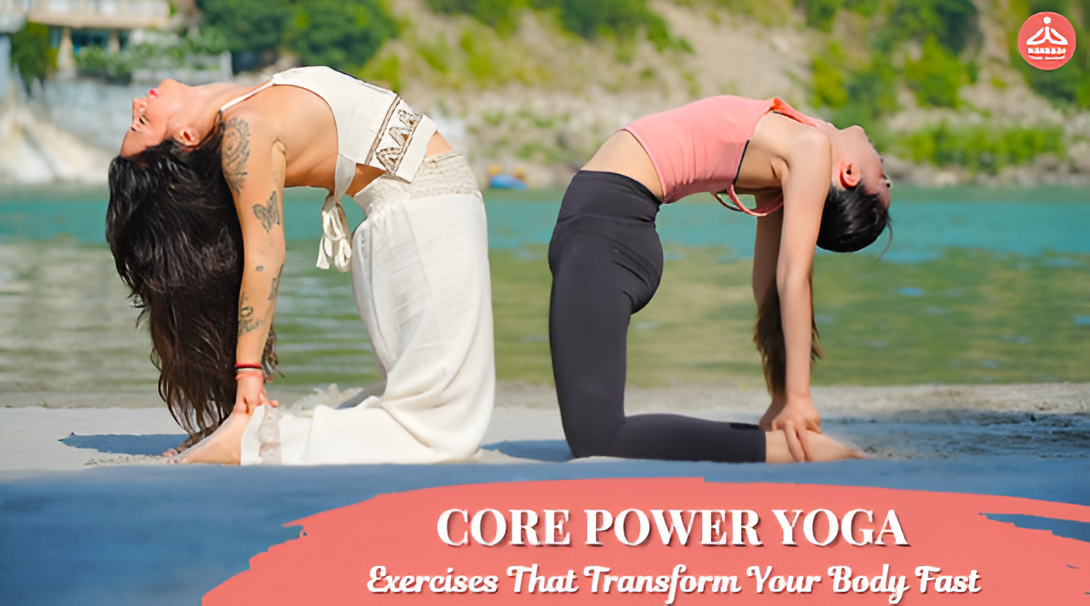
The core lays the groundwork for every action that your body performs. When you carry your groceries, work at your desk, or do yoga, your core is centering everything that you do. People don’t usually pay enough attention to their core or they train their core inappropriately.
Core power is far more than just six-pack abs or flat stomachs. Strengthening your core helps improve the functioning of the muscles that support the spine, helps you maintain good posture, improves balance and provides you with the confidence to move around easily.
In this blog post, we detail 10 of the most powerful core strength-building exercises grounded in yoga and proved by modern science and how committing to working on these exercises effectively in Rishikesh will vastly improve your transformation.
WHAT IS CORE POWER - AND WHY DOES IT MATTER?
Your core consists of the muscles that surround your midline; Rectus Abdominus (front), Oblique (sides), Transverse Abdominus (deep) Multifidus (lower back), and even pelvic floor and diaphragm.
An investigation documented in PMC (NCBI) in 2024 demonstrated that core strength training greatly enhances muscle size in abdominal and lumbar muscles and protects your lower back while improving performance throughout the body.
Core power can also enhance your strength; particularly with the help of yoga-type exercises, it will teach you how to use your breath, increase body awareness, and improve the ability to concentrate: three things that most typical gym exercises do not incorporate.
10 CORE POWER EXERCISES TO TRANSFORM YOUR BODY
1. Plank Pose (Phalakasana)
The plank exercise is a universal standard of core power training. It works your deep core, shoulders, glutes and quadriceps muscles all together. A recent study from 2024 in the Journal of Strength & Conditioning Research found that variations of plank exercises activate both the shoulder and scapular muscles significantly, making them to be one of the safest and best total body stabilizing exercises. Hold for 30 to 60 seconds with your navel pulled in and breath freely.
2. Boat Pose (Navasana)
A study published in the International Journal of Yoga determined that Navasana, or the “Boat Pose”, had a higher activation of the rectus abdominis muscle than any other pose reviewed. It also engages the hip flexors, spinal stabilizers, and quadriceps muscles. To perform this pose sit on the floor and lean back slightly while raising both legs off of the ground and holding that position with straight legs, starting with bent knees and advancing from there.
3. Chaturanga Dandasana (Low Plank)
Chaturanga Dandasana involves more core muscular contraction than plank positions and activates the pelvic floor muscles, which are necessary for effective, efficient breathing and maintaining a stable spine. In lowering from High Plank into Low Plank, your triceps, pectorals, and deep abdominals muscles will all engage concurrently, making this an extremely effective exercise for developing both upper body strength and core stability through Yoga.
4. Warrior III (Virabhadrasana III)
According to the Yoga Journal, Warrior III pose is best suited for achieving 360-degree engagement of the core. When balancing on one foot while holding this pose, both your front, back and side abdominal muscles engage simultaneously, which is how your body functions in real life: dynamic and functional control of the abdominal muscles. Hold for five to 10 breaths on each side.
5. Side Plank (Vasisthasana)
Side Planks are an excellent exercise for strengthening the oblique muscles, which are often overlooked by most people. The Side Plank not only works the core by creating a lateral lift from your feet to your hips, but it also helps to align your spine more effectively, as well as improve wrist and shoulder strength. Additionally, research indicates that Side Plank will also help to activate the lumbar multifidus, a deep muscle that assists in protecting the spine against injuries.
6. Bird Dog
A study published by the NCBI in 2024 categorises the Bird Dog as one of the top 7 core stability exercises. Start from a tabletop position (hands and knees), then simultaneously reach one arm and one leg straight out in opposite directions. This is a unique cross-body movement that enhances your ability to coordinate, develop anti-rotation strength, and strengthen deep stabiliser muscles, all of which are necessary for maintaining a healthy lower back.
7. Bridge Pose (Setu Bandhasana)
Bridge Pose is designed to target the posterior chain (glutes, hamstrings, lower back), while the deep abdominals provide support for stabilising the pelvic region; bridge pose is our most fundamental core power exercise, and can help counteract the effects of sitting for long periods of time. A single leg bridge is a more advanced level of difficulty for this exercise.
8. Dead Bug
Start lying on your back, arms pointed to the ceiling, knees bent at about 90 degrees. Gradually lower one arm toward the floor along with the opposite leg. It is essential to maintain pressure in your lower back while lowering both of these extremities towards the earth. These movements have been shown through scientific studies to be one of the safest forms of core activation since there is no spinal compression involved - this exercise is appropriate for both novice and advanced practitioners alike!
9. High Lunge with Twist
Starting in high lunge (one leg forward) rotate your torso towards your front leg. This challenges your hip flexors, works your obliques and opens your thoracic spine all while being a difficult exercise that requires balance and power in your core. That is why it is a popular pose in corepower yoga classes!
10. Dolphin Plank
The dolphin plank is very similar to the forearm plank (think row) except for more active (engaged) shoulders. It builds both endurance in the lower core and upper back at the same time because of this engaged shoulder. Try holding it anywhere from 30-45 seconds and concentrate on pulling your navel up towards your spine with each exhale. This happens to be a great preparation for beginner level inversions; in particular, headstand and forearm stands, as you progress towards advanced core power yoga inversions.
THE SCIENCE: WHY YOGA-BASED CORE TRAINING WORKS
According to a study released on Healthline, power yoga can boost and maintain your heart rate while improving muscle strength and burning calories at an appreciable rate. It was also noted in a 2017 study that practising power yoga lowers cortisol (the stress hormone that has been associated with weight gain around the stomach and fatigue) levels.
When you infuse breath awareness in conjunction with the below mentioned core power exercises, the benefits are amplified. By combining slow, controlled breathing with core training, you engage your "rest and digest" system (the parasympathetic nervous system), decrease tension in the surrounding muscles and allow for deeper engagement of stabiliser muscles that are oftentimes missed in high-impact gym workouts.
As stated in an article by Biology Insights, "the practice of yoga produces measurable changes (adaptations) in musculoskeletal, cardiorespiratory and neuroendocrine systems", which provides a level of overall health improvement rather than just focusing on abdominal definition.
For the full science on power yoga and calorie burning, see: https://www.healthline.com/health/what-is-power-yoga
HOW OFTEN SHOULD YOU TRAIN CORE POWER?
Ideally, you should do 3-5 sessions/week of core power training. Because the core muscle groups recover faster than large muscle groups (like legs or back), multiple shorter-duration training sessions (>1 listing per week) yield greater results than 1 long-duration training session each week. In fact, 20 minutes of focused core power training/18-20 days can generate noticeable and functional results in approximately 4-8 weeks.
DEEPEN YOUR PRACTICE AT RISHIKESH YOGA ASHRAM
If these exercises have inspired you, it may be time for you to expand your exploration beyond just the physical body but also into philosophy.
Rishikesh Yoga Ashram is known as one of the best yoga schools in Rishikesh, and is a premier yoga school in India that provides a combination between core strength training and knowledge of the various aspects of yoga, including asana, pranayama, anatomy and alignment, in every program we provide.
The 200 Hour Yoga Teacher Training in Rishikesh provides you with a full foundation in yoga philosophy, sequencing, and body mechanics, and includes working on your core alignment and strength.
If you wish to continue onward in your journey, the 300 Hour Yoga Teacher Training in Rishikesh takes you to new depths of your education and focuses on refining how you teach and yourself as a teacher.
Finally, if you're just starting off, the 100 Hour Yoga Teacher Training in Rishikesh is an excellent choice as a beginner. The structure is supportive, and the experience of being there is transformative.
Rishikesh Yoga Ashram is located along the banks of the Holy Ganga River in the foothills of the Himalayas, where ancient wisdom is combined with contemporary scientific understanding and also where your core power training practice will be lifelong.
For further reading on core stability science, visit: https://pmc.ncbi.nlm.nih.gov/articles/PMC11036226/
BOTTOM LINE
The core is much more than just muscle. Your core is at the centre of your body's physical ability to perform work, as well as your body's foundation for postural support. Additionally, it is your body's primary defence mechanism against injury and fatigue. Therefore, by intentionally training your body with yoga-based core power movements – which not only tone up your stomach – but also change how you carry yourself, how you move through your daily life, and how you feel in your own body will all transform once you begin this process.
If you are doing these ten core power exercises at home, or if you are ready to begin a complete core-train program in Rishikesh, you have just received your starting point; start today, your body will thank you!
FREQUENTLY ASKED QUESTIONS
Q1. What is Core Power?
Core power refers to the functional strength of your midsection (abdominal area) muscles. These muscles include lower back, pelvic floor and diaphragm muscles, as well as oblique and transverse abdominal muscles. In yoga, core power can be defined as the combination of physical strength, breath regulation and mental focus, which creates the ultimate mind-body exercise experience. On the other hand, there is also a popular yoga company called CorePower Yoga. Trevor Tice started CorePower Yoga in Denver in 2002.
Q2. Who owns CorePower Yoga?
CorePower Yoga was founded by Trevor Tice in 2002 after a climbing accident led him to discover yoga's transformative benefits. The brand grew into one of the largest yoga chains in the United States, with studios including corepower encino, corepower mission bay, corepower yoga glenview, corepower yoga poway, core power austin, core power glenview, corepower yoga west loop, corepower yoga westwood, and corepower yoga ward, among many others.
Q3. Can you lose weight with Core Power?
Yes. Power yoga raises and sustains heart rate, builds lean muscle mass, and reduces cortisol - all of which support fat loss. Somatic yoga for weight loss and core power training both address stress-driven weight gain. Combined with a healthy diet, regular core power yoga sessions are an effective and sustainable part of any weight management plan.
Q4. What is the 30/30/30 rule for weight loss?
The 30/30/30 rule for weight loss states that the first thing you should do after waking up is to consume 30 grams of protein within 30 minutes of waking up and then low-intensity exercise for 30 minutes. This rule is designed to stabilize blood sugar, lower cortisol levels and promote fat metabolism. Following this rule along with morning corepower yoga is a great way to assist in your weight control efforts.
Q5. What are the disadvantages of power yoga?
The drawbacks of power yoga include that it is physically demanding, making it less than ideal for those new to yoga, expectant mothers, or anyone else recovering from injury; improper alignment when practicing may result in lower back pain, wrist pain and/or shoulder pain. It is necessary to be taught by an experienced instructor, such as those who have completed the 200 Hour Yoga Teacher Training course in Rishikesh, before progressing.
Q6. Which exercise burns 1000 calories in 1 hour?
Caloric expenditure during fitness activities that burn approximately 1,000 calories in 1 hour typically include high intensity exercise such as jogging at high speed, competitive bicycle riding or circuit training. The calorie expenditure achieved by power yoga, which includes exercises targeting the abdominal muscles during core power sequences, is approximately 400 - 600 calories/hour. Power yoga alone will not achieve a caloric expenditure of 1,000 calories; however, by increasing lean muscle mass, you will increase your basal metabolic rate thereby allowing you to burn greater amounts of calories throughout each day.
Q7. Is core power actually a good workout?
Yes! Core power yoga improves both your muscular endurance as well as your muscular strength through yoga-based core strengthening training, coupled with an increase in cardiovascular endurance, decreased levels of stress hormones, and a heightened awareness of the way your body moves. Core yoga train all the aspects of physical fitness; mental focus; breath control; while most traditional gym-style programs do not train all of these aspects at the same time.

