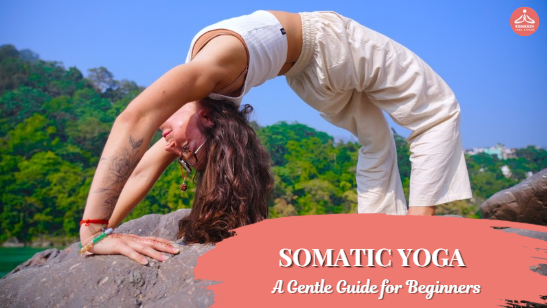
Do you ever find yourself feeling exhausted and tense after a night of adequate sleep? Do your shoulders continue to feel tight, even after stretching? Your body may be experiencing stress in ways that your mind has not yet recognized. This is where somatic yoga comes into play!
In this article, we will discuss what is somatic yoga, how it works and why it will be one of the most gentle and effective practices you do this year.
WHAT IS SOMATIC YOGA?
Somatic yoga is an awareness-based movement practice that incorporates both traditional yoga positions and somatic principles; in other words, it combines movement with the understanding that healing can only start from within the body and not externally.
The word somatic comes from the Greek term soma meaning "body". The development of somatic yoga stems from research conducted by Dr. Thomas Hanna who explored how our nervous system retains stress and tension within the body. Several years later Dr. Peter Levine continued this research by demonstrating that trauma and stress actually reside within your muscle tissue, your neuromuscular system, and throughout your entire body along with your mind.
Thus while traditional styles of yoga focus mainly on how the postures appear on the outside, the question Somatic yogis will ask is "How am I feeling on the inside?"
Somatic Yoga is a slow, conscious form of movement that emphasizes listening to rather than forcing the body.
SOMATIC YOGA VS NORMAL YOGA - WHAT IS THE DIFFERENCE?
"How is Somatic Yoga different from traditional yoga?" is another common question I receive from first time students trying Somatic Yoga. Here is a brief summary to help you understand.
Traditional Yoga emphasizes proper posture and alignment, develops strength and flexibility, and follows a predetermined series of postures. Somatic Yoga emphasizes how your body feels with every movement (and how you can release stored tension in the muscles), retraining the nervous system to become more relaxed, and moving slowly in an exploratory manner without performance pressure.
THE SCIENCE BEHIND SOMATIC YOGA
Here is what research tells us:
1. It Calms the Nervous System: According to research, when you perform slower, more mindful movements, you activate the parasympathetic nervous system, which is responsible for the body's "rest and digest" mode. Therefore, when we are too stressed from our, "fight or flight," stress response, the activation of this part of our nervous system can offset the effects of being in a constant state of tension. (Streeter et al., 2012; Pascoe et al., 2017)
2. It Reduces Cortisol: There is significant interest in the use of somatic yoga for cortisol detoxification as research has demonstrated that mind-body practices, such as somatic yoga, are effective in reducing the levels of cortisol, a stress hormone, that contribute to weight gain, difficulty sleeping and compromised immune function.
3. It Supports Healing from Trauma: Clinical research studies published in the Journal of Clinical Psychology indicate that practicing yoga for trauma can reduce the symptoms of anxiety and depression, while simultaneously increasing the effectiveness of the body's nervous system in regulating itself. Somatic yoga for trauma has been found to be especially effective in the healing of trauma due its application at the level of the body vs. the mind.
4. It Increases the Body's Awareness: Proprioception refers to the ability to perceive the position of the body, or certain body parts, in relation to the rest of the body and/or the other objects in the surrounding environment. Somatic yoga exercises facilitate the enhancement of this awareness in the body through improved balance, posture and coordination.
5. It Enhances Immune & Respiratory Health: Yoga and somatics for immune and respiratory health serves as a primary means of movement and regulating the nervous system have positive effects on improving the overall health of the immune system and the lungs.
SOMATIC YOGA BENEFITS YOU SHOULD KNOW
If you are an experienced yogi, the benefits of somatic yoga are wide-ranging:
These include:
- Releasing chronic muscle tension and stiffness.
- Reducing stress and anxiety naturally.
- Supporting somatic yoga for trauma recovery.
- Lowering cortisol for better sleep and improved mood.
- Enhancing one's awareness of their body and posture.
- Increasing mental clarity and emotional stability.
- Supports somatic yoga mind-body wellness
- Helps with somatic yoga for weight loss by reducing the effects of overeating due to stress, as well as helping to support a healthy metabolism.
SIMPLE SOMATIC YOGA POSES FOR BEGINNERS
You can practice these six somatic yoga poses within minutes or without needing any prior expertise if you're interested:
1. Body Scan Savasana - On a flat surface and lie with your whole body's weight pressing down onto the ground; focus completely on how each area from soles of feet to the top of your head feels while lying there (No movement necessary; only awareness).
2. Pelvic Clock - Lying on your back with knees bent, use your hips to move in small semi-circular patterns. This can relieve tightness/tension in lower back and/or hip areas.
3. Spinal Wave - Start at the base of the tailbone and slowly roll the spine over itself (not through lateral movement, but through gentle length-wise undulating) until your head reaches up towards the sky. This gets us back in touch with the spine through sensory input from everything going through our bodies (aka through our physical senses).
4. Somatic Side Stretch - Sitting or laying down, stretch one arm over top of head and reach out to the side. Breathe into your rib cage and hold for 30-60 seconds, paying close attention to how everything feels as you hold however long you are doing so.
5. Supine Twist - Lying on back, bring knees up toward chest before crossing legs over each other until they all land flat on ground. Use gravity as a tool so that your legs move more freely than they usually would.
6. Child's Pose with Breath Awareness - When you're in Child's Pose, put your forearms and forehead directly on the ground and close eyes, before taking slow deep breaths into the lower spine. Your lower spine should expand until it becomes completely relaxed after each exhale.
You do not need to be flexible or have any previous experience at all to practice any of the above somatic yoga poses! They are excellent beginners' starting points!
DOES SOMATIC YOGA WORK?
The response to whether somatic yoga is an effective way to lose weight based on the current research literature is yes and researchers are beginning to catch on to something practitioners have already been aware of for a long time. Somatic yoga is most effective when practiced on a regular basis with curiosity and a sense of exploration. Initially the changes are often quite subtle such as sleeping better or noticing less tension in your shoulders or becoming calmer when you experience stress; however, over a period of weeks or months, somatic yoga can create significant change, particularly in people who struggle with chronic pain, trauma, anxiety and/or burns-out.
For further reading on the science, visit: https://www.ncbi.nlm.nih.gov/pmc/articles/PMC10380079/
IS SOMATIC YOGA GOOD FOR WEIGHT LOSS?
Somatic yoga for weight loss is not a traditional method of burning calories; it addresses one of the main reasons for weight gain, which is chronic stress. Chronic stress causes an increase in cortisol, which leads to weight gain (especially around the abdominal area) because excess cortisol promotes fat storage. Slow, mindful movement in somatic yoga will help to reduce cortisol levels and subsequently promote a healthier metabolism, as well as decrease emotional eating. Somatic yoga is most beneficial when practiced with an active and balanced lifestyle.
TAKE YOUR PRACTICE DEEPER IN RISHIKESH
The fact that you connect with and are interested in somatic yoga could indicate that you want to explore your own connection between your body and mind on a deeper level. Many aspects of somatic yoga (such as developing an inner awareness of self, breathing consciously and being still) are prevalent in the ancient teachings of Yoga (the traditions from which all modern-day forms of yoga originate).
These same concepts are the foundation for what we teach at the Rishikesh Yoga Ashram - one of the best yoga schools in India. Our 200 Hour Yoga Teacher Training in Rishikesh, will provide you with the basic understanding of Yoga Philosophy, Anatomy, Pranayama and Mindful Movement, which all correspond to somatic principles. We conduct our Teacher Training Course in Rishikesh, at the base of the Himalayas and along the banks of the River Ganges.
If you're only interested in doing something shorter or you haven't done any yoga before, our 14 Days Yoga Retreat in Rishikesh would be a great way to get started. You don't need any prior experience, just an open mind and a willingness to listen.
You may be looking for a comprehensive source of information about somatic yoga training, whether for personal development or teacher training, the best somatic yoga training program starts with a solid foundation in classical presentation as this is what we provide at the finest yoga school in Rishikesh, India.
You can also explore how yoga supports the nervous system here: https://www.somatopia.com/blog/yoga-s-effects-on-the-nervous-system-science-backed-benefits-for-trauma-recovery
BOTTOM LINE
Somatic yoga teacher training is all about finding your way back into your body; it is not just the perfect position. In a fast-paced world that pushes you to be productive, to do more than you think possible, somatic yoga offers you the opportunity to slow down, go inwards, and access the innate knowledge already present in your body through the wisdom of your body. The best somatic yoga program can be practised by anyone, regardless of their level of experience, and offers those with any level of stress, tensions, or trauma a way to heal.
If you are ready to move into a deeper space, the foothills of the Himalayas await you; as well as, Rishikesh Yoga Ashram, the best yoga school in Rishikesh., is more than happy to assist you.
FREQUENTLY ASKED QUESTIONS
Q1. What's the difference between somatic yoga and normal yoga?
Compared to traditional forms of yoga that emphasize the achievement of specific postures with focus on alignment/form; Somatic yoga looks at how you feel inside when moving. This style has a slower pace, is exploratory in nature, and is intended to re-train the brain instead of building strength/flexibility like other styles.
Q2. Does somatic yoga really work?
Absolutely! Many studies show that doing slow movements/exercises have a direct impact on reducing muscle tension, lowering cortisol, helping people process their emotions more clearly, calming the nervous system, and producing positive personal outcomes (better sleep, less pain, lower levels of anxiety and improved feelings about life) when practiced regularly.
Q3. Is somatic yoga good for beginners?
Definitely!! Beginners can start doing SOMATIC YOGA because none of the poses/or exercises require flexibility nor any experience whatsoever; you need only lie down, breathe deeply and observe how you feel in your body.
Q4. What time of day is best for somatic yoga?
Morning classes will begin the day with a calm, grounded nervous system. Evening classes can assist you in releasing accumulated tension from your body before falling asleep. Either way, using somatic yoga will benefit your mind and body, and you should choose a time that allows you to be free from distractions. As long as you are consistent with your time, both times will be beneficial to you.
Q5. Can yoga flatten your belly?
Yoga may not flatten your stomach directly, but may provide indirect support through the reduction of cortisol in your body, modulation of your digestive system, and a decrease in stress that can contribute to bloating. Somatic yoga for cortisol detox is especially effective in terms of the cortisol detoxifying process. Using a healthy diet and maintaining an active lifestyle in combination with regular somatic yoga practice can lead to a flatter stomach over time.
Q6. What should I wear to somatic yoga?
You should wear soft, comfortable clothing that is not too tight or restrictive and will allow for free movement and adequate airflow during the exercise. Since most of the exercises in a somatic yoga class will be done lying on the floor or in a seated position, avoid tight fitting clothes with firm waistbands or rigid materials.
Q7. How many times a week should you do somatic yoga?
Doing 3 to 5 sessions each week provides an excellent baseline for great success in somatic yoga programming. Even when just practicing for 15-20 minutes a day, you can create significant improvements in your body awareness and your nervous system. Somatic yoga can be performed daily without risk of overtraining because it uses lower-intensity exercise than many other forms of exercise.

