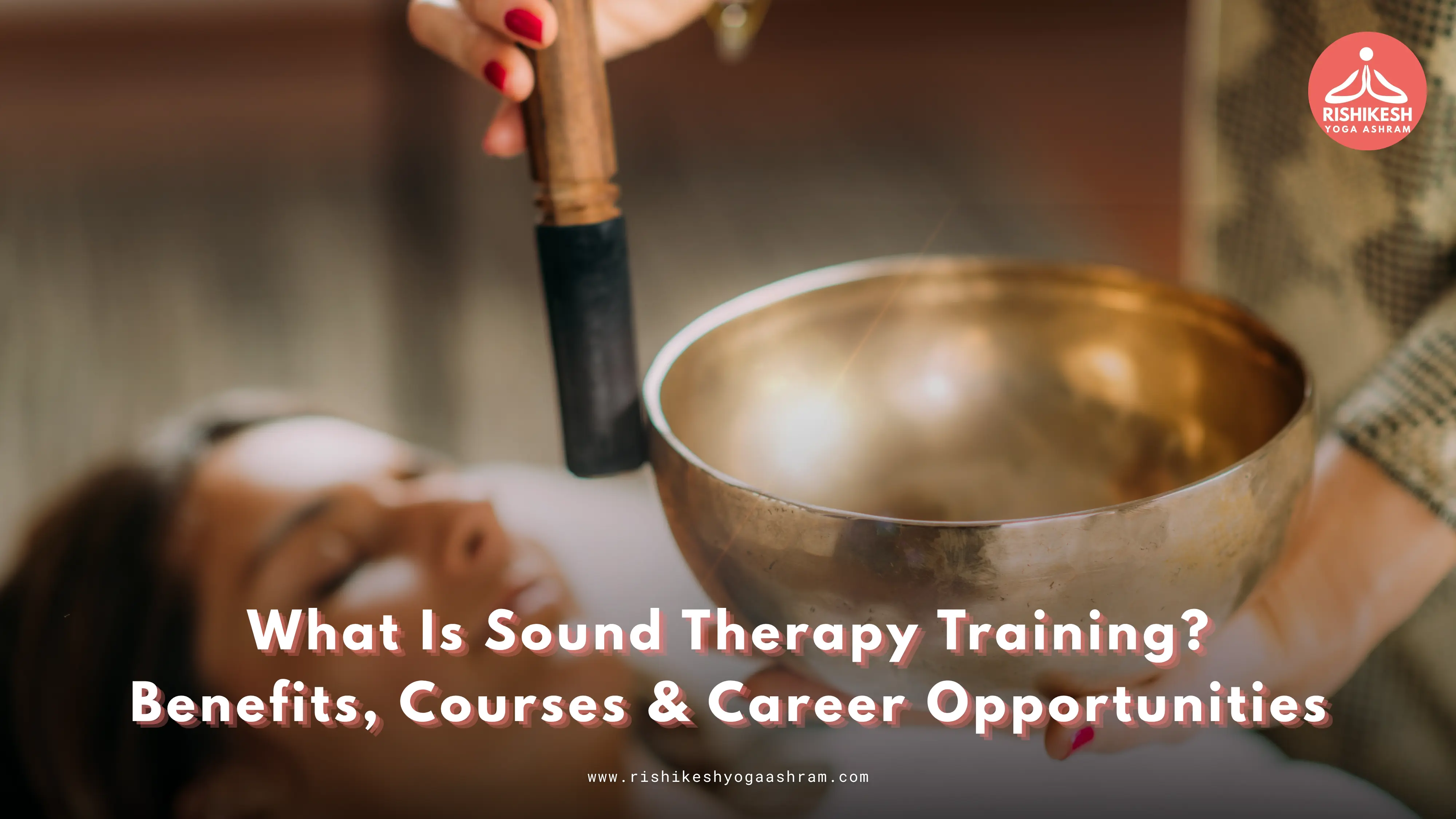
Close your eyes while doing a Tibetan singing bowl session, and you will feel the changes within a few minutes: your shoulders are dropping, your breath is slowing down, and your mind is getting quiet.
It is the reason why Sound Therapy Training is developing quickly and becoming more popular among yoga teachers, wellness specialists, and interested novices.
In this article, we would like to explain what exactly Sound Therapy Training is, what it is based on, what topics it covers, and how it can provide you with opportunities for starting a real career whether you study online or in the place where healing traditions were born – Rishikesh.
What Is Sound Therapy Training?
Sound healing therapy training is a structured education process that teaches you how to apply sound, vibration, and tone through different instruments, including Tibetan bowls, crystal bowls, gongs, tuning forks, and your voice, in order to attain relaxation, emotional stability, and wellbeing. It usually combines three basic aspects: theory of sound and vibrations, practical instrument mastery, and necessary skills for providing safe guidance through the therapy process.
Proper sound healing therapy education goes deeper than “how to play a bowl,” unlike a simple YouTube tutorial. The course deals with resonance and entertainment principles, includes information about how sound impacts the human nervous system, how to structure a session, ethics, and how to work professionally with potentially vulnerable individuals experiencing anxiety and distress.
The Science Behind Sound Therapy
It’s really fair to ask if sound healing therapy training actually works or it’s merely an enjoyable routine. Current research shows that a famous observational study published in the Journal of Evidence-Based Integrative Medicine reveals that the sound of singing bowls reduces tension and negative mood on a consistent basis, which results in a drop of anxiety in stressful situations. In addition, it has become known that first-time participants of the sound meditation have reported experiencing greater tension relief than those who have tried it before.
A more recent randomized controlled trial has provided direct comparison of Tibetan singing bowls and progressive muscle relaxation along with a control group. According to the results of the singing bowl group, they experienced an improvement in anxiety levels and an increase in heart rate variability which is considered as the sign of a more relaxed state.
The review concludes that Tibetan singing bowl sessions show real promise for stress management and psychological wellness, offering a low-risk, non-invasive complementary tool in both clinical and everyday contexts. While researchers caution that the research is in its infancy and designs vary widely, they find a consistent positive association between Tibetan singing bowls and beneficial outcomes related to stress, mood and relaxation.
In summary: sound therapy may not cure illnesses but studies indicate it is a useful technique for relieving stress, regulating emotions and calming the nervous system and that's what makes it a perfect fit with yoga and meditation.
What You Will Learn in a Sound Therapy Training Program
A comprehensive sound healing therapy training course generally covers:
- Introduction to sound and vibration theory - understand the concepts of frequency, resonance, and the speed of sound fluctuations through the body.
- Instrument practice - study of the techniques of playing Tibetan and crystal bowls, gongs, tuning forks, chimes, and drums in a safe manner.
- Designing sessions - learn how to design a meditation session using sound, and the necessary sequencing and closing of the practice.
- Using your voice as an instrument - learn how to use your voice for sound healing, through the methods of toning sounds and chanting.
- Anatomy and the nervous system - general concept on how sound cooperates with the human nervous system.
- Ethics and safe practice - who should be excluded from sound therapy, the importance of informed consent, and staying attentive to the needs of clients who go through deep emotions.
- Marketing and building a practice - in most cases, the courses also include information on how to start providing sound therapy.
There are specific programs which concentrate on the field of vibrational sound therapy training that delve deeply into the study of resonance and entertainment or sound bath therapy training which concentrates on conducting calm group sessions rather than practicing special techniques for healing individual clients.
Sound Therapy Training Online vs. In-Person
Sound therapy training online is incredibly in demand today. It makes the process of education flexible, as you can go back to the lessons you need and study from any part of the planet. Online sound therapy may be a good option for those who already have experience in yoga and meditation and who want a self-paced study process.
Yet, an on-site immersion - especially in places where there is a vibrant culture of mindful practices - provides an advantage which online education cannot give. One of the points to note is that this form of education allows you to get real-time feedback from instructors and be part of a group during the studies. This makes people combine online classes with the experience of immersion, for instance, at some of Top Yoga School In Rishikesh, which is a place where sound and mantras are important spiritual elements for years.
The Five and Six Healing Sounds
A common example of a traditional method that can be discovered as part of sound therapy is the Chinese system of Qigong, also referred to as the Six Healing Sounds (Liu Zi Jue). In this technique, a particular sound is associated with each of five main organ systems: liver, heart, spleen, lungs, and kidneys. The sixth sound is related to the general energetic state of the body. Each sound is used while performing a slow and quiet breath with an intention focused on bringing the balance to the respective organ system in question. A lot of courses incorporate this technique into their practice with singing bowls and toning being used because it shows that different cultures around the world came to the same conclusions about the healing properties of the sound.
Who Should Be Cautious With Sound Healing?
Sound therapy is a safe and effective method, however certain groups should take note when using these techniques.
- Epilepsy patients or individuals with a history of seizures should take caution when dealing with sound technology.
- Severe mental health issues are another aspect to be taken seriously. For instance, people experiencing psychosis are recommended to consult medical professionals before using sound therapies.
- Pregnant women should be mindful of sound techniques that may involve gongs or bowls in direct contact with their body.
- Another group to take precaution are people using medical devices such as pacemakers. Strong vibrations applied over the body may disrupt the functioning of the device in question.
- Individuals dealing with some sort of trauma may need to consult trauma-focused specialists instead of sound practitioners.
Career Opportunities After Sound Therapy Training
After completing the certification, graduates will be able to:
- Conduct private sound healing sessions addressing issues such as stress relief, sleep disorders, or overall wellness
- Provide group sound baths in facilities, retreats, or wellness centers
- Use sound therapy within a current yoga, meditation, or Reiki healing practice
- Offer sound-based relaxation techniques that join corporate wellness programs
- Integrate sound healing work and your yoga teacher career - especially after having graduated from a 200-hour Yoga Teacher Training in Rishikesh that most of the schools offer courses on sound and mantra.
Using sound therapy alone brings good results but it works in a much more effective way when combined with yoga, meditation, or body work as that is what a lot of practitioners do.
Why Study Sound Therapy in Rishikesh
Rishikesh has a long-standing reputation as the birthplace of yoga, which is reflected in its history with sound that goes hand-in-hand with the practice of mantra recitation, kirtan, and meditation along the banks of the Ganges.
Yoga teacher training in Rishikesh gives you the chance to learn sound healing techniques in the same environment that boasts thousands of years of practice and wisdom, and not just from books but from people steeped in this living tradition.
If you are considering going to a yoga retreat in Rishikesh or doing a yoga instructor training in India, it is logical for you to make use of this added knowledge and make the next step toward learning sound therapy.
Bottom Line
Sound Therapy Training enables the student to learn the properties of sound like vibration, resonance, and tone and utilize them for relaxation and emotional balance in the body. The program should contain both theoretical knowledge of the science behind the sound, as well as practical knowledge and skills for usage of instruments together with the facilitation skills. Regardless of whether one chooses sound therapy training online or a full course at one of the best Yoga schools in Rishikesh, this is a useful skill to be obtained, as it goes well with yoga, meditation, and holistic approaches.
Curious about combining sound healing with a deeper yoga foundation? Explore our 200 Hour Yoga Teacher Training in Rishikesh and residential yoga retreat programs at Rishikesh Yoga Ashram - training at one of the region's most respected yoga schools.
FAQs
1. What is Sound Therapy Training?
It is a formal study of science and practical skills of how to use sound and vibrations through instruments like singing bowls, gongs, tuning forks, and voice for relaxation, stress relief, and emotional healing.
2. What are the 5 healing sounds?
The five healing sounds refer to the specific organ sounds used in Chinese Qigong originating from the five major organs, namely - liver, heart, spleen, lungs, and kidneys - to be used together with breathing and visualization and thus release tension.
3. What will I learn in a Sound Therapy Training program?
In a sound therapy training program participants generally learn the physics of sound and resonance, playing instruments like singing bowls and gongs, arranging and conducting sessions, safety and ethics.
4. How long does it take to complete Sound Therapy Training?
There is no one answer to this question; in the case of foundation courses, they usually take from a few hours to a few days, while practitioner programs accredited by professional organizations take from 100 to 200 hours.
5. Who should not do sound healing?
Individuals suffering from epilepsy, actively experiencing any psychosis, having pacemaker, any other implanted organ, and females expecting pregnancy need to take extra caution or just stay away from certain techniques.
6. What are six healing sounds?
The Six Healing Sounds (Liu Zi Jue), is a qigong exercise form in China where an extra sixth tone is used besides the usual five healing tones for the organs of the body to achieve a perfect health balance.
7. Can sound frequencies really heal?
Current research shows sound and vibration can meaningfully reduce stress, tension, and anxiety and support relaxation and nervous-system regulation, but it should be seen as a complementary wellness tool rather than a replacement for medical treatment of any diagnosed condition.

