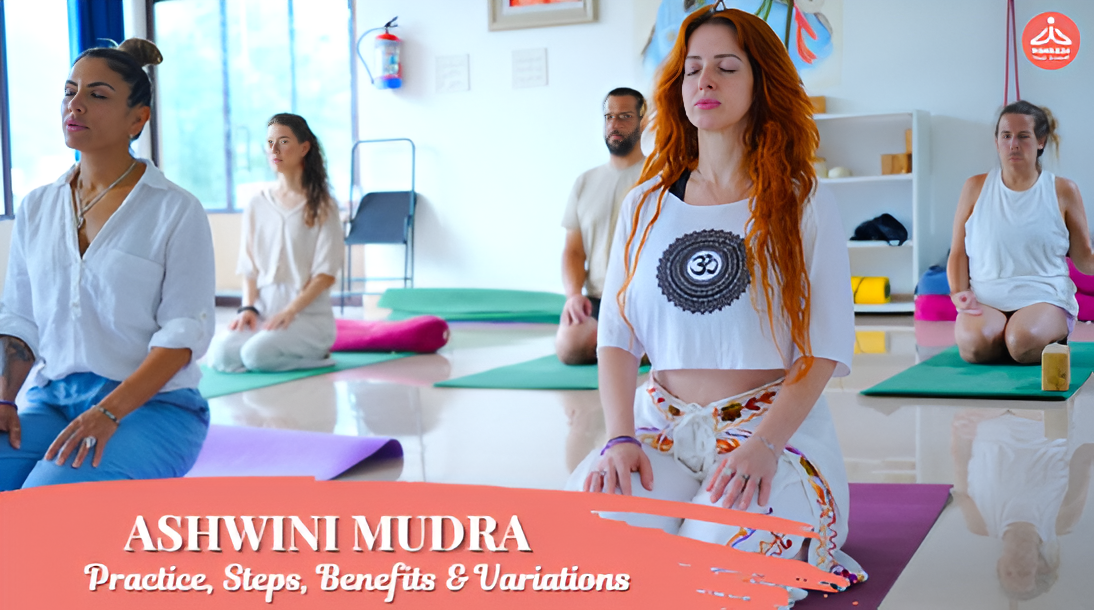
Yoga has many very potent practices that are often nearly unnoticed. Ashwini Mudra is one such example; it does not require any sort of special equipment, complex posture and can be done while sitting in a chair, lying down to sleep or in the midst of a meditative experience–no one will be able to see it being done by you, though.
An apparently small, subtle and quiet practice like Ashwini Mudra has been performed in various yogic traditions for thousands of years. It is extremely beneficial in strengthening the pelvic floor, encouraging energy flow, aiding digestion, and cultivating a relaxed, focused mind.
This guide provides you with everything that you might need in order to practise Ashwini Mudra (what ashwini mudra is, how to do it with step-by-step instructions, the scientifically-proven benefits of practising, variations that you might find useful in your practice, and any precautions that you should take), then let’s get started!
WHAT IS ASHWINI MUDRA?
The term ashwini mudra is composed of two words from the language of Sanskrit; the first word is ashwin, which means horse, and the second word is mudra, which means gesture or seal. The name ashwini mudra is derived from the movement of contracting and relaxing of the anal sphincter muscle, which is done rhythmically, in a similar manner that a horse does moving its hindquarters.
Like hand mudras or hamsapaksha mudra, ashwini mudra yoga differs in that it engages the practitioner’s internal muscles to achieve its benefits; therefore, it is one of the most deeply connected practices within yoga.
Among Hatha Yoga's traditional texts are both Hatha Yoga Pradipika and Gheranda Samhita; both contain references to ashwini mudra as a very effective means of conserving one's vital energy (prana), activating the Muladhara (root) chakra, and setting the stage for deeper levels of meditation.
HOW TO PRACTISE ASHWINI MUDRA - STEP BY STEP
Be sure that you are comfortable and in a tranquil place before starting. You may wish to sit in Sukhasana, Padmasana, or Vajrasana, or you can lie down with your knees bent.
1. Get settled and breathe. Close your eyes, then take several slow deep breaths 3 to 5 to achieve tranquillity and calmness of both body and mind. Allow any tension that may exist in both the abdomen and the lower part of your body to subside.
2. Inhale Take a slow, steady inhalation through your nose while simultaneously contracting the anal sphincter muscles by squeezing and pulling them upward so as if to prevent passing gas.
3. Hold the contraction for a number of seconds (3-5 seconds). Ensure that the rest of the body, including face, jaw, and abdomen, remain relaxed while only the anal sphincter muscles remain engaged.
4. Exhale and release After exhaling, slowly release the anal sphincter contraction from the above action.
5. Repeat Doing one cycle makes up an entire series (one). Start at 10-15 repetitions per session and build up to 30-50 repetitions in time as you develop your awareness and strength.
Performing this exercise consistently with the above noted process will promote fluid and meditative movement that establishes a rhythm through contraction and relaxation at the base of your body to anchor awareness at that location.
ASHWINI MUDRA BENEFITS - WHAT SCIENCE AND TRADITION BOTH SAY
1. Strengthens the Pelvic Floor
This is the most often referred to as Ashwini mudra benefit in the literature. According to studies, strengthening exercises focused on your pelvic floor (such as ashwini mudra) have been shown to increase muscle strength by as much as 70% when performed on a regular basis for 12 weeks. A stronger pelvic floor will help with bladder control, reduce occurrences of urinary incontinence, assist with support for reproductive health, and help to protect your lower back and spine.
Dr. Kegel first introduced pelvic floor exercises (also known as Kegel exercises) in 1948 as a way to help individuals who suffer from SUI - a type of incontinence in which you leak urine if you sneeze, cough, or engage in physical activity. Ashwini mudra engages the same muscle group as Kegel exercises, but as an additional benefit to your muscles, the ashwini mudra provides you with an energetic and meditative element that Kegel exercises do not provide.
2. Activates the Parasympathetic Nervous System
The contraction and relaxation of the anal sphincter creates direct stimulation of the sacral nerves, which then stimulate the parasympathetic nervous system (PSNS) or the body's "rest and digest" response. In turn, stimulation of the PSNS lowers your heart rate, reduces levels of stress hormones, supports healthy digestion, and induces a sense of calmness and mental clarity.
3. Revitalises the Psycho-Neuroendocrine System
A study conducted by Nagammanavar and Natekar in 2020 shows that ashwini mudra can be used to revive the entire psycho-neuroendocrine system which includes all the glands, organs and nervous systems working together to keep the hormone balance of the entire body. This also makes this mudra helpful for adolescents, menopausal women and anyone experiencing an imbalance in hormones or fatigue from stress.
4. Improves Digestion and Relieves Constipation
The rhythmic contraction of ashwini mudra will gently massage the abdominal organs helping with peristalsis (the wave-like motions within the intestinal tract), increasing the flow of blood to the area of digestion and encouraging regular bowel movements. Traditional yoga texts state that ashwini mudra is helpful for dealing with hemorrhoids, constipation, and maintaining healthy rectal function.
5. Awakens the Muladhara Chakra and Pranic Energy
According to yogic philosophy, ashwini mudra will create an awakening of the Muladhara (root) chakra which is responsible for stability, grounding, and the basic aspects of human survival. By consistently performing this mudra you are directing apana vayu (the downward moving life force) upward through the sushumna nadi (the central channel), energizing the whole body and allowing you to have a foundation for deeper meditative and kundalini practices.
6. Supports Reproductive and Sexual Health
Ashwini mudra enhances blood circulation to the pelvic region while toning the muscles of the reproductive organs, supporting reproductive health, including fertility, menstrual cycles for women, and sexual vitality for men and women. It can also be used to prevent pelvic organ prolapse and to aid a woman's body after having a baby.
7. Reduces Anxiety and Builds Mental Focus
Regularly practicing Ashwini Mudra reduces anxiety by stimulating the vagus nerve through engagement of the pelvic floor; by using the action of focused awareness to create a very small, internal contraction; and by developing the ability to concentrate (dharana), which is the beginning step to preparing for meditation.
VARIATIONS OF ASHWINI MUDRA
Slow Ashwini Mudra - Each contraction is sustained for 5 to 10 seconds before being released. Used to increase muscular endurance and develop deeper kinesthetic awareness.
Rapid Ashwini Mudra - Quick, fast-paced contractions and releases that do not last a long time. Used to stimulate blood flow and vibrancy of energy through the body in a more dynamic way.
Ashwini Mudra with Kumbhaka - Inhale, contract the pelvic floor, hold your breath and the contraction at the same time, then exhale and release contraction. This is the more powerful ancient form found in the Hatha Yoga Pradipika; it should be performed under supervision.
Siddhasana is an ideal asana in which to practice Ashwini Mudra because the heel presses against the perineum to enhance the Energy effect of the Mudra and is a preferred position in traditional Kundalini practices.
RELATED MUDRAS - UNDERSTANDING THE FAMILY
Ashwini Mudra belongs to the family of perineal Mudras which involve redirecting the Prana from the lower to the upper part of the body by working with the perineal muscle area.
Sahajoli Mudra is the women's version of Vajroli Mudra and involves contracting the vagina and urethra to increase blood flow and balance reproductive hormones. Sahajoli Mudra is associated with the Svadhisthana chakra (Sacral Chakra, also known as the Creative Center) and enhances Creativity, Reproductive health and Concentration. In the Hatha Yoga Pradipika, Sahajoli Mudra is said to stimulate "spontaneous" arousal of spiritual energy.
Vajroli Mudra is the men's version of Sahajoli Mudra and involves contracting the urogenital muscle (Pelvic Floor) to assist in moving energy through the Urethra and to the Brain.
Sahajoli and Vajroli Mudras are both located in the Sacral Chakra while Ashwini Mudra is primarily located in the Root Chakra. Together, these three Mudras form a powerful trio for Pelvic Floor Health and Pranic Elevation.
For deeper scientific reading on pelvic floor mudra practices, see: https://journals.lww.com/yomi/fulltext/2014/46030/exploring_the_significance_of__mudra_and_bandha_.2.aspx
PRECAUTIONS
- Women who are pregnant should not do ashwini mudra because it could create tension on the pelvic region and uterus, which could be harmful.
- Consult your physician or therapist if you have had pelvic or abdominal surgery before continuing with this practice.
- Practice this technique in a controlled manner; do not force the technique; there should always be movement that is gentle and controlled; never use force to do this technique.
- If you experience any pain, discontinue the practice and consult a qualified yoga instructor.
DEEPEN YOUR MUDRA AND YOGA PRACTICE IN RISHIKESH
For full understanding of the ashwini mudra on a physical level, energetic level and spiritual level, you need a qualified instructor who understands these teachings as they were traditionally taught.
The Rishikesh Yoga Ashram is one of the world's leading yoga schools and is widely considered to be one of the best yoga schools in India. The ashram teaches these practices of mudra and bandha as part of their regular curriculum as foundational means of controlling prana (the life force in your body) and facilitating transformation at a deeper level.
At Rishikesh Yoga Ashram, our best 200 hour yoga teacher training in india is based on a clear framework and methodology and includes specific training on mudra science, pranayama, asana, anatomy, and yogic philosophy. All students in our 100 Hour Yoga Teacher Training receive a strong foundation in yoga, and guidance on the practice of mudra, pranayama, and alignment.
The best way for you to get started with serious yoga practice is with our 100 Hour Yoga Teacher Training in Rishikesh. With a focus on foundational yoga techniques such as breath work, mudras, and alignment, this program will prepare you for a life-long journey on your mat.
If you are particularly interested in a vigorous style of yoga, then you may want to consider enrolling in our Ashtanga Yoga Teacher Training in Rishikesh. This program will take a closer look at one of the most comprehensive and powerful styles of yoga by emphasizing both bandha and mudra work as an integral part of the practice. Through the application of these techniques, you will gain a deeper understanding of all that is encompassed in Ashtanga yoga.
For further reading on ashwini mudra benefits and its clinical research basis, visit: https://pharmeasy.in/blog/health-fitness-benefits-of-ashwini-mudra-and-how-to-do-it/
BOTTOM LINE
Our most recommended practice is the ashwanimudra - one that in its size may appear small but can cause significant change in such areas as pelvic strength, healthy digestion, balanced hormone levels, an active nervous system and laying an energetic foundation for your meditation practice.
To engage in this practice, no mat, studio or special clothes are required. Just you, your breath and the intention to devote a few moments of quiet awareness towards your body each day. Start with 10 repetitions and maintain your effort; it may be surprising what a little gesture can do to create a significant change from within to your outer world.
If you are interested in participating in practices such as these with depth and authenticity, the Rishikesh Yoga Ashram is ready to join you on this journey.
FREQUENTLY ASKED QUESTIONS
Q1. What are the benefits of Ashwini Mudra?
Some of the numerous ashwini mudra results are strengthening the pelvic floor muscles, improving bladder control, intestine health (better digestion and relieving constipation), having lower stress and anxiety levels through activating vagus nerve, balancing hormones, increasing pranic energy, and advancing reproductive and sexual wellness. It was also shown in a 2020 study to strengthen and support your psycho-neuroendocrine system, thereby improving your mental and physical health.
Q2. How do you perform Ashwini Mudra?
To practice the ashwini mudra, sit or lie down comfortably with your spine straight, inhale slowly, and contract the muscles of the anal sphincter, by squeezing them and pulling them up to your belly button while inhaling deeply. Hold the contraction for 3-5 seconds; then exhale and completely release. Each cycle consists of one contraction and one relaxation. When you start out as a beginner, you can do between 10 and 15 cycles per session. While doing ashwini mudra yoga, the rest of your body should remain relaxed; only the anal area will be used.
Q3. Is Kegel Exercise and Ashwini Mudra the same?
Kegel exercise and Ashwini mudra are similar, but not identical. Both exercises work on the pelvic floor muscles and provide similar physical benefits. The key difference between the two is that Ashwini mudra is a holistic practice that is accompanied by breath awareness, meditation, and the intention of raising prana upwards, whereas Kegel exercises, developed by Dr. Kegel in 1948, are purely physical. Ashwini mudra provides the same physical benefits as Kegel exercises, but also connects with the nervous system, works with chakra activation, and allows for conscious management of energy.
Q4. What is Ashwini and Vajroli Mudra?
Ashwini mudra involves the contraction and relaxation of the anal sphincter muscles in a rhythmic manner, primarily activating the Muladhara chakra (root chakra) and strengthening the rectal and lower pelvic areas. Vajroli Mudra is a more advanced form of Hatha Yoga for men that involves the contraction of the urogenital system and is associated with the Svadhisthana chakra (sacral chakra). The female equivalent of Vajroli is Sahajoli mudra. All three mudras are perineal mudras and are used to redirect downward-moving prana (apana vayu) upward through the central channel of energy within the body.
Q5. Can beginners practise Ashwini Mudra?
Yes, it is a practice that does not require previous yoga training or a high degree of flexibility. It is classified as a beginner level mudra, and is one of the easiest to perform out of all types of mudras used in the system of Hatha Yoga. The only requirement to perform this mudra is the practitioner's ability to contract the anal sphincter which can be done by everyone from the beginning. A beginner should begin with gentle contractions for a period of time without force, and increase the number of repetitions they are performing per day over several weeks.
Q6. How many times a day should you practise Ashwini Mudra?
The ideal number of times to perform this mudra each day is 1-3 times per day with a particular emphasis on morning and evening. The number of repetitions per session will vary from 10 to 50 depending on the level of experience. No matter what, consistency is more important than the intensity of performing this mudra than any physical strength that will help you to be successful with the muscular control required for performing Ashwini Mudra. Practising daily with a gentle approach and for a minimum of several weeks will not produce the same results as infrequent sessions of high intensity practice. Practitioners who are training in Rishikesh will typically incorporate mudras into their daily morning routines for their pranayama and meditation practices.
Q7. Are there any side effects of Ashwini Mudra?
Ashwini Mudra performed in a gentle, correct way will not cause harmful side effects, but practising the ashwini mudra incorrectly (i.e., using too much force and rapid contractions) could result in muscle fatigue and/or soreness in the pelvic region. Women who are pregnant should avoid using this asana. Individuals with active pelvic infections, are currently recovering from a surgical procedure, or experiencing any form of pelvic pain should consult a qualified medical professional for advice before attempting this asana. It is highly recommended that you find an experienced teacher to instruct you on how to perform this mudra before attempting any combination of this yoga practice with breath retention.

