.png)
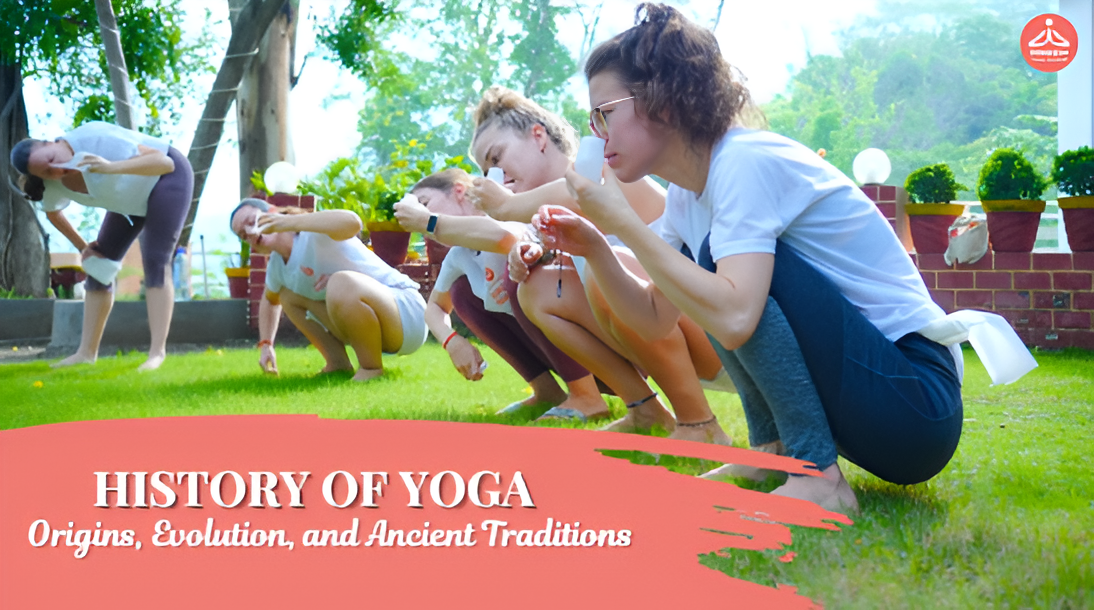
“Yoga” is everywhere these days, as evidenced by local yoga studios, health & wellness apps, and travel brochures for yoga retreats! However, yoga has a fairly long and rich evolution, far from “just” today’s yoga mats and breathable clothing. The history of yoga consists of sages; scripture; and an evolutionary process of an ancient spiritual science that is credited for influencing the evolution of our human civilization.
If you are curious about the origins of yoga or the meaning of yoga in our modern world, this guide walks you through the earliest foundations of yoga.
The Pre-Vedic Period: Yoga Before Written Records
The earliest evidence of where yoga originated has not been found in written records, but rather in stones! Archaeological excavations of cities of the Indus Valley Civilisation (Mohenjo-Daro and Harappa) that date back to approximately 3000 - 1800 B.C.E., have discovered carved seals depicting people in meditative poses sitting cross-legged with their spines straight, similar to how most people sit while meditating today.
The pre-Vedic period represents the first stage of yoga. There are no written records documenting this time period; yoga practice was raw, intuitive, and not formalized as an organized system of practice. Historical researcher Georg Feuerstein, a highly regarded expert on the ancient historical development of yoga, points out that the evidence of practice during this time frame predates recorded history for approximately several hundred years prior to the formalization of Hinduism as a formalized religion.
The Vedic Period (1500–500 BCE): Yoga Enters the Scriptures
The development of yoga took a turn by the ancient Indian civilization and marked an important new stage of the development of yoga. Yoga concepts were first recorded in religious literature with the Rig Veda, which was likely to have been written about 1500 BC, providing us with examples of three main aspects of yoga — practice of discipline; self-awareness; and connection between the individual mind and higher consciousness.
The root form of the word 'yoga' in Sanskrit (yuj) means to connect; unite; or join. The concept of connecting was also understood in early literature as a connection (or bridging) between the physical body and spiritual body; as well as the individual self and the universal Self.
The Vedic Seers (Rishis) were believers that there existed a way of creating higher levels of consciousness through the practice of rites, mantras, and rituals (yoga). However, yoga was not considered to be primarily a practice of incorporating postures or physical movements, but more so a method of developing the mind spiritually and mentally.
The Upanishadic Period (800–200 BCE): Yoga Goes Deeper
The historical development of yoga made a significant leap forward during the time of the Upanishads. These 200+ texts represent a transition away from the ritualistic practice of yoga towards a more direct and personal experience. Questions about who we are, what consciousness is, and what liberation means became predominant themes.
The Katha Upanishad was one of the first texts to use the term "yoga" in a modern way, referring to the control of sense and the quieting of the mind. The Shvetashvatara Upanishad provides detailed instructions on how to sit, breathe, and meditate.
During this time, yoga began to describe itself as a means to attain moksha, which is liberation from reincarnation.
The Bhagavad Gita (circa 200 BCE): Yoga as a Way of Life
Without the Bhagavad Gita, no history of yoga in English could be whole. Within the huge epic known as the Mahabharata lies the 700 verses of conversation between Krishna (the lord of the universe) and the warrior Arjuna. The Bhagavad Gita is perhaps the most well-known single book of yoga texts ever written.
The Bhagavad Gita describes four different paths of yoga:
- Jnana Yoga - The Path of Knowledge/Wisdom
- Bhakti Yoga - The Path of Devotion/Love
- Karma Yoga - The Path of Selfless Action
- Raja Yoga - The Path of Meditation/Mental Discipline
Krishna tells Arjuna: "Yoga is skill in action." Yoga does not remove you from this world but connects with you and other living persons on a complete and aware level. This concept changed yoga from an exclusively ascetic (meaning only for monks and nuns) activity into a means available to every single person on this earth to practice every day.
Patanjali and the Classical Period (circa 400 CE): Yoga Gets a System
Patanjali's contributions to the evolution of yoga occurred during the classical age (around 400 CE) when he came up with a new way of organizing yogic philosophy through his writings, called the Yoga Sutras. The Yoga Sutras consist of 196 short verses that serve as a foundation for what we now think of as classical yoga.
Patanjali is credited with the creation of the Ashtanga Yoga system, or an “Eight Fold Path” which contains the following eight limbs of yoga:
- Yama – ethical conduct or moral restraint
- Niyama – personal observances or disciplines
- Asana – physical postures
- Pranayama – breath control
- Pratyahara – withdrawal of the senses
- Dharana – concentration
- Dhyana – meditation
- Samadhi – oneness/nirvana/enlightenment
Asana is only one aspect or limb of yoga; there are seven other limbs that accompany it. In Patanjali's view, physicality to a yogi is only a beginning in their practice. In addition, Rishikesh, a city located in the foothills of the Himalayas, became an outstanding laboratory for the evolution of classical yoga. To this day, the Ashtanga Yoga School in Rishikesh teaches and continues to pass down the lineage of these principles through the study of Patanjali's eight limbs.
The Post-Classical and Tantra Period (500–1500 CE): Yoga Honours the Body
The post-classical period (500-1500 CE) of yoga is characterized by the emphasis of the body within many of the spiritual traditions, including tantra, hatha yoga, and others. Unlike traditional yoga, which viewed the physical body as an impediment to liberation (of the spirit), tantras and hatha yogas began to view the physical body and the physical experience as a direct way to achieve ultimate liberation. Due to this change in perspective, numerous texts—Hatha Yoga Pradipika, Gargya Siddhanta, Guhyapadma, etc.—emerged detailing many of the postures, breathing techniques and basic principles of how to lock or control the flow of energy (called bandhas) in the physical body as powerful spiritual tools. These texts are the foundations for most of the yoga and hatha yoga practiced in studios today.
The history of development of yoga is therefore not a straight line - it is a dialogue between traditions that saw the body very differently, and both left lasting marks.
Modern Yoga: From India to the World
The diffusion of Yoga on a global scale started in a big way during the late 1800s and early 1900s through Swami Vivekananda's introduction of the philosophy behind Yoga to the West during the 1893 Parliament of World Religions held in Chicago. Later, modern practitioners such as Tirumalai Krishnamacharya, B.K.S. Iyengar, Pattabhi Jois, and Swami Sivananda developed systems and frameworks around using physical practice as a means to popularise and describe the philosophy that existed prior to their systematisation of what yoga represents.
Rishikesh is home to some of the most long-standing and accepted institutions dedicated to teaching Yoga in the world. For example, Rishikesh Yoga Ashram offers a 200-Hour Yoga Teacher Training In Rishikesh that provides not only instructional techniques on posture-based training but also a thorough curriculum on the philosophy of yoga, the Sanskrit language, the use of pranayama, and the classical texts; a level of detail and engagement that clearly ties back to Patanjali and the Upanishads.
To ensure that the yoga teacher training in Rishikesh is authentic; individuals should look for schools that follow traditional methodologies rather than contemporary trends. Although certified schools are found all over the world via the Yoga Alliance; the greatest amount of living wisdom regarding Yoga can be found where Yoga started.
Bottom Line
Yoga has been around longer than any other form of exercise, as it has been a discipline that dates back over 5000 years. It provides an overview of the human condition, how we experience suffering, and how to be liberated from those conditions.
From seeing the seal carvings in the pre-Vedic period to the Sutras from the Yoga philosopher Patanjali to his practice on the banks of the Ganges River in Rishikesh at sunrise, each event connects. Each person has walked into a class, looking for their path to enlightenment, or long-term yoga teaching.
A yoga teacher training india is simply a stepping stone to continue your life-long path.
FREQUENTLY ASKED QUESTIONS
Q1. What religion does yoga come from?
Yoga has its roots in the spiritual traditions of ancient India. Its origins can be traced back to the Vedic tradition and have evolved over time with many different beliefs, including Hinduism, Buddhism and Jainism. Although yoga has a very strong connection to all three of these religions, it is not a religious practice; rather, it is a combination of philosophy and a physical discipline that can be practised by people of all religions.
Q2. What is the first name of yoga?
The word yoga was derived from an ancient Sanskrit word meaning "to join or unite something together as one." The term was not used to describe the practice of yoga until approximately 200 CE and developed through the various Vedic rituals performed in Hinduism during Vedic and Upanishadic times and has evolved through the works of Patanjali; all three of these phases are found in the Ashtanga yoga of Patanjali.
Q3. What are the 4 periods of yoga?
The four main stages of the main history of yoga are 1) the pre-classical stage, which covers the timeline of yoga from its inception to the early Vedic period, 2) the classical stage, which covers the time frame of the Yoga Sutras, created by Patanjali, 3) the post-classical stage, which covers the time frame of the initiation of Hatha and Tantra and their introduction into the world, and 4) the current modern stage of yoga, which emerged post-19th century.
Q4. Which god created yoga?
According to Hindu tradition, yoga was created by the deity Lord Shiva, the Adiyogi or first yogi. Through the legend of his divine energy, Shiva is said to have passed on to the seven sages known as the Sapta Rishis the knowledge of yoga and thus yoga was propagated throughout the world. Lord Krishna, as he appeared in the Bhagavad Gita, represents a key figure within the formation of yoga.
Q5. What does the Bhagavad Gita say about yoga?
According to The Bhagavad Gita, yoga represents the whole philosophy of life that has been outlined in four different ways (Jnana - Knowledge, Bhakti - Devotion, Karma - Actions, and Raja - Mediation). In addition to showing how we can live a complete life with awareness, equanimity and commitment; Krishna has stated that “yoga is skill in action”.
Q6. Where did yoga originate?
The origin of yoga is in Ancient India. The earliest known evidence of yoga comes from the Indus Valley Civilisation, dated to approximately 3000 BC; through time, there is significant development of yoga in the Vedas, Upanishads and Bhagavad Gita, culminating in the systematization of Patanjali (around 400 AD).
Q7. Is yoga only about physical postures?
No, only one part (asanas) out of the eight limbs of yoga created by Patanjali is related to asanas. There are also other aspects to the complete system, including ethical precepts, breathing exercises, meditation, and the ultimate goal of achieving inner freedom. The main focus of modern western yoga is on the physical postures of the body however traditional yoga is a holistic way of being; integrating the body, mind, and spirit.

